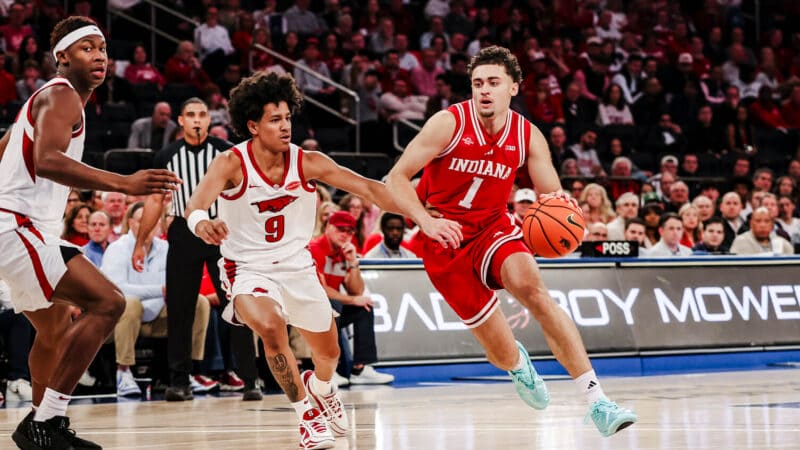
With two and a half minutes remaining Tuesday night at Madison Square Garden, Indiana trailed No. 20 Arkansas by four points, facing the kind of late-game adversity that has often troubled the Hoosiers in recent seasons.
But this Indiana team responded differently.
Behind consecutive 3-pointers from Darren Harris and a go-ahead logo-distance triple from Bryce Lindsay, the Hoosiers rallied for an 81-76 victory, improving to 5-0 and securing their first ranked win of the season.
It was more than an early-season victory over a quality opponent. For a program attempting to work its way back into national relevance, Tuesday offered its first meaningful glimpse of just how far Indiana has come.
DeVries’ first season in Bloomington served as a foundation for the program’s rebuilding process. The Hoosiers showed promise but lacked the consistent physicality, rebounding and interior production necessary to compete with the Big Ten’s better teams.
Those shortcomings shaped DeVries’ approach to the transfer portal, where he prioritized adding size, strength, and athleticism to his roster.
And in Indiana’s first significant test against a nationally ranked opponent, those offseason decisions paid dividends.
The Hoosiers outrebounded Arkansas 39-28, collected 15 offensive rebounds and generated 21 second-chance points. Against a Razorbacks team boasting considerable size and athleticism, Indiana didn’t shy away from the physical challenge. It embraced it.
That was particularly evident in the opening half.
Indiana immediately established its presence inside, jumping out to a 9-2 lead thanks to transfer additions Samet Yigitoglu and Aiden Sherrell.
The two big men quickly became the focal point of Indiana’s offense, consistently establishing position in the paint and capitalizing on opportunities around the basket.
As the Hoosiers’ perimeter players struggled to generate offense, Yigitoglu and Sherrell carried the load.
The duo combined for 29 of Indiana’s 36 first-half points, shooting 10-for-14 from the field and grabbing nine rebounds. Meanwhile, the rest of the Hoosiers combined for just seven points and one made field goal.
Indiana’s guards struggled to find a rhythm and the Hoosiers entered halftime without a made 3-pointer in three attempts.
Yet Indiana still led 36-34.
It was a testament to the frontcourt production DeVries sought throughout the offseason, but maintaining that advantage would require a different approach after halftime.
Arkansas began limiting Indiana’s interior opportunities, holding Yigitoglu scoreless in the second half and forcing the Hoosiers to find production elsewhere.
This time, the backcourt answered.
Markus Burton connected on the Hoosiers’ first 3-pointer of the evening at the 16:29 mark for a 45-42 lead. A few moments later, Lindsay hit a corner three and a layup before finding Harris for a transition dunk that extended Indiana’s lead to 61-54.
The offensive balance that had been noticeably absent in the first half suddenly emerged. Still, Arkansas refused to go away.
The Razorbacks gradually chipped away at Indiana’s advantage, using their athleticism and aggressive attacking style to create opportunities. Billy Richmond III eventually gave Arkansas a 67-66 lead with 4:48 remaining, setting the stage for a dramatic finish.
When Indiana fell behind 74-70 with just over two minutes remaining on a JJ Andrews 3-pointer, the Hoosiers faced their biggest moment of adversity yet.
Rather than allowing the game to slip away, they responded with the composure and toughness DeVries has sought to instill.
Harris buried consecutive 3-pointers to give Indiana a 76-74 advantage. After Arkansas answered with a thunderous dunk by Miikka Muurinen to tie the game, Lindsay delivered the decisive blow, connecting on a deep 3-pointer with 25 seconds remaining.
Harris sealed the victory with two free throws in the closing seconds.
“We guarded the three until we didn’t,” Arkansas head coach John Calipari said afterward, pounding the table for emphasis.
“It’s contagious,” Calipari added. “They’re snipers.”
After failing to make a single 3-pointer in the first half, Indiana shot 5-for-9 from beyond the arc after halftime. Harris scored 15 of his game-high 18 points in the second half, while Lindsay delivered the night’s biggest shot.
The offensive contrast illustrated something significant about Indiana’s rebuilt roster.
When its guards couldn’t generate offense, Yigitoglu and Sherrell provided a reliable interior presence. When Arkansas adjusted to limit the frontcourt, Indiana’s perimeter players found their rhythm.
Sherrell finished with 17 points and six rebounds, while Yigitoglu added 17 points and 10 rebounds. Their contributions helped establish the physical foundation for a victory ultimately secured by the Hoosiers’ guards.
But perhaps the most encouraging development had little to do with individual production.
Indiana didn’t play a perfect game. Its offense experienced prolonged stretches of inconsistency, Arkansas repeatedly seized momentum and the Hoosiers found themselves trailing in the closing minutes.
Contrary to past seasons, they found a way to win.
For a program working to reestablish itself among college basketball’s better teams, that resilience represents an important step forward.
One November victory doesn’t guarantee a return to the NCAA tournament or sustained success throughout Big Ten play. It provides tangible evidence that DeVries’ offseason changes have made Indiana better equipped to compete in these moments.
The Hoosiers are bigger, more physical, and increasingly able to win in different ways.
With another major test awaiting Friday against Kentucky in Indianapolis, Tuesday’s win might be remembered as the first sign that Indiana’s rebuilding process is producing something more substantial.
The Hoosiers haven’t arrived yet, but they’re starting to look like a team capable of fighting its way back.